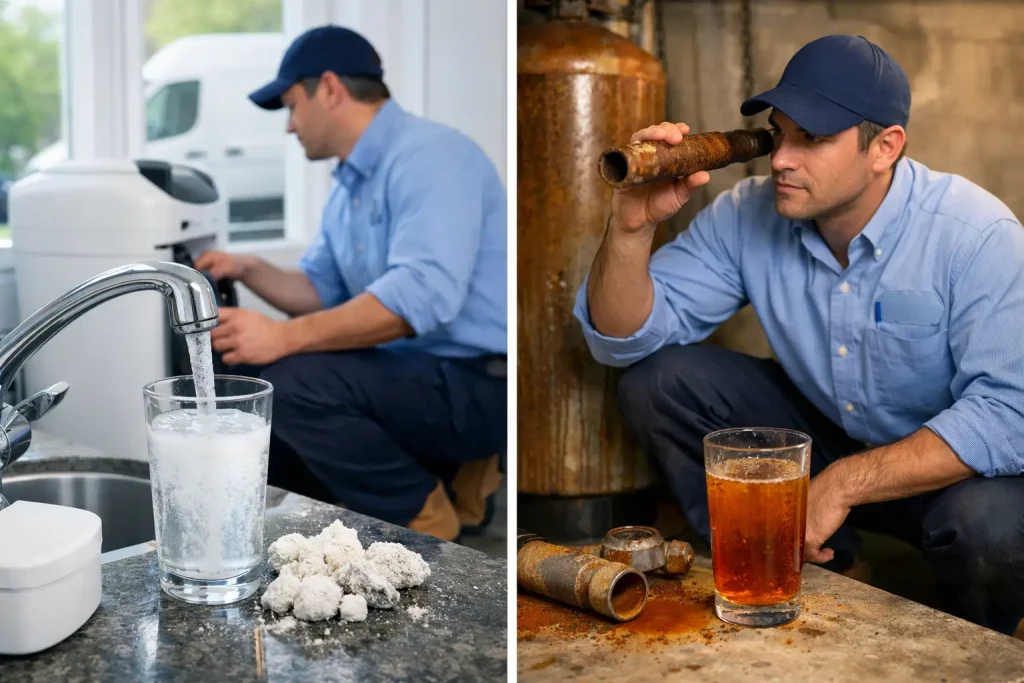
Orange staining around a toilet bowl and white scale on a showerhead can both point to a water-quality issue, but they do not have the same cause or the same fix. When comparing hard water versus iron water, the practical difference is this: hard water is primarily a mineral issue, while iron water contains dissolved or suspended iron. A home can have one problem, or both at the same time.
That distinction matters before adding equipment to a well-water system. The wrong treatment approach can leave staining, reduce water flow, create extra maintenance, or fail to protect fixtures and appliances as expected.
Hard Water Versus Iron Water: What Is Different?
Hard water contains elevated levels of dissolved calcium and magnesium. These minerals are common in groundwater and are not usually obvious when you first fill a glass from the tap. Their effects tend to show up gradually throughout the plumbing system.
Iron water contains iron, often picked up as groundwater moves through soil and rock. Iron may be clear when it first comes out of the tap, then turn yellow, orange, reddish-brown, or even black after it meets oxygen. Depending on the type and amount of iron present, it can cause visible particles, metallic-tasting water, staining, and buildup in plumbing components.
Neither issue should be diagnosed by appearance alone. Water with a high hardness level can leave little white crust on faucets without any discoloration. Iron can be present without making the water look rusty at the tap. A proper water test gives the information needed to choose a treatment system that suits the supply.
Signs of Hard Water in a Home
Hardness is often most noticeable in the places where water is heated, evaporates, or mixes with soap. Common signs include white or gray scale on fixtures, cloudy spots on glassware, soap that does not lather well, and dry-feeling skin or hair after bathing.
Inside the plumbing system, hard water can create scale in water heaters, tankless units, pipes, dishwasher components, and washing machines. Over time, that buildup can affect heat transfer and restrict flow through smaller passages. A shower may lose pressure, for example, not because the well pump is failing, but because mineral scale has narrowed the showerhead or valve components.
Hardness is not usually a sudden emergency. It is a long-term maintenance and performance concern. The amount of hardness matters, as does the home’s water use, equipment type, and whether a property relies on a well.
What hard-water scale can affect
Scale is especially hard on equipment that heats water. Water heaters, tankless heat exchangers, humidifiers, boilers, and appliances can all require more frequent service when hardness is not managed. A water softener is commonly used to reduce calcium and magnesium, but it needs to be sized, installed, and programmed for the home’s actual water conditions.
Signs of Iron Water
Iron problems are usually easier to spot. Reddish-brown staining in toilets, sinks, tubs, laundry, and around drains is a familiar sign. Homeowners may also see orange sediment in a toilet tank or notice that white laundry develops yellow or rust-colored marks.
Iron can also affect water pressure. As iron oxidizes, it can form deposits in fixtures, cartridge filters, aerators, pressure switches, and plumbing lines. This is particularly relevant for well systems, where water moves from the well pump through a pressure tank and treatment equipment before reaching the house. If water flow has dropped, the cause could be a plumbing restriction, filter blockage, pump issue, pressure-tank problem, or a combination of these factors.
A metallic taste or earthy smell can occur with iron, although odor may also point to other conditions, such as sulfur compounds or bacteria. Iron bacteria are another possibility in some wells. They are not the same as dissolved iron. They can create a slimy buildup, foul odor, and recurring clogging that may require a different response than standard filtration alone.
Why One Treatment System Does Not Always Solve Both Problems
A conventional water softener is designed mainly to remove hardness minerals. In some situations, it can also remove a limited amount of dissolved clear-water iron. However, using a softener as the answer to a significant iron issue can lead to fouling, frequent regeneration, resin problems, and ongoing maintenance.
Conversely, an iron filter may remove iron effectively while leaving calcium and magnesium behind. The orange staining may stop, but scale can continue to build on fixtures and water-heating equipment.
The right order of treatment is also important. Some homes need sediment filtration before other equipment. Others may require oxidation and filtration to convert dissolved iron into particles that can be captured. If hardness remains high after iron treatment, a softener may be added downstream. The system depends on test results, water flow needs, household occupancy, and the condition of the existing well and plumbing.
Do not assume that a larger filter is automatically better. Oversized or incorrectly configured equipment can waste water, fail to backwash properly, or create avoidable service issues. Undersized equipment can allow staining and hardness to return during periods of higher use.
Start With a Complete Water Test
The most useful first step is testing the water before selecting equipment. At minimum, the test should identify hardness, total iron, manganese, pH, and other conditions that influence treatment performance. If there is an odor, slime, unusual color, or concern about contamination, additional testing may be needed.
It also helps to identify where the sample is taken. A sample collected before existing treatment equipment tells you what is coming from the well. A sample after treatment shows whether the equipment is doing its job. Testing only at a kitchen faucet may not reveal whether a problem starts at the water source, in the treatment system, or in aging plumbing.
For homes with a private well, water quality should not be treated as a one-time project. Seasonal groundwater changes, heavy rainfall, repairs to the well system, and changes in household demand can all affect what reaches the home.
Information a technician will need
Before recommending a softener, iron filter, or combined treatment system, a qualified plumbing professional will usually review the water test and ask about staining, odors, pressure concerns, equipment age, household size, and water use. They may also inspect the pressure tank, existing filters, bypass valves, drain connections, and the available electrical supply for treatment equipment.
This site review matters because water treatment is connected to the rest of the property. A blocked filter can look like a pressure problem. A failed pressure tank can make treatment equipment cycle poorly. A poor drain arrangement can prevent a backwashing filter or softener from operating correctly. Looking at the full system prevents a narrow fix for what may be an interconnected problem.
Practical Treatment Options for Well Water
For hardness alone, a properly selected ion-exchange softener is often the practical choice. It reduces the calcium and magnesium that form scale, improving soap performance and helping protect water-using equipment. Softened water may not be necessary at every tap, depending on the property’s layout and the homeowner’s preferences.
For iron, treatment may involve a sediment filter, an oxidizing filter, aeration, chemical oxidation, or another filtration method suited to the form of iron in the water. Manganese, low pH, sulfur odor, and iron bacteria can change the recommended design. That is why a treatment plan should be built around measured conditions rather than a single visible stain.
Some properties benefit from combined systems that address iron and hardness together. Others are better served by separate stages that are easier to maintain and troubleshoot. The best choice is the one that delivers consistent water quality without creating unnecessary complexity for the homeowner.
When to Arrange a Plumbing Assessment
Arrange an assessment if staining is worsening, filters clog repeatedly, water pressure has dropped, a water heater is scaling up, or a current softener or iron filter no longer seems effective. Sudden changes in water color, taste, odor, or available water should also be investigated, especially on a private well.
For homeowners across Leeds and Grenville, SDR Electric, Plumbing & Heating can assess the plumbing and well-water treatment side of the system together, including the equipment, drainage, electrical requirements, and water-flow concerns that affect long-term performance.
Clear water is not always problem-free water, and stained water does not automatically mean the same solution for every home. A current water test and a careful look at the whole system give you a sound place to start – before mineral buildup or iron deposits turn into a larger plumbing issue.