A standby generator can sit quietly for months, then become the most critical piece of equipment in your building during an outage. This guide to commercial generator maintenance explains what property owners and facility managers should monitor, what needs qualified service, and how a consistent maintenance plan helps protect people, equipment, and business operations.
For a retail space, apartment building, office, farm operation, restaurant, or industrial facility, generator reliability is not just about whether the engine starts. The generator, automatic transfer switch, fuel supply, batteries, ventilation, electrical distribution, and connected loads must all work together. A weak link in any one of those systems can prevent backup power from reaching the equipment that needs it.
Why Commercial Generator Maintenance Cannot Wait for an Outage
Most generator failures are preventable. Batteries lose charge, fuel degrades, hoses harden, terminals corrode, filters become restricted, and control panels can develop alarms that go unnoticed. A generator may start during a short no-load test but still struggle when it must carry an elevator, refrigeration equipment, fire and life-safety systems, sump pumps, servers, or essential lighting.
Regular maintenance gives your team time to identify those issues under controlled conditions. It also creates a service record that helps technicians spot repeat problems, plan parts replacement, and verify that testing has been completed according to the manufacturer’s requirements and applicable building or life-safety standards.
The right schedule depends on the generator’s size, fuel type, run hours, age, environment, and the role it serves. A unit supporting optional convenience loads will not always require the same testing approach as a generator serving legally required emergency systems. Your maintenance plan should match the equipment and the risk to the building.
Commercial Generator Maintenance Basics
A dependable program has three parts: routine site checks, scheduled professional maintenance, and documented operational testing. Staff can handle basic observations when they have been trained to do so. Electrical, fuel, engine, and transfer-switch service should be completed by qualified technicians who can work safely around live equipment and rotating machinery.
Start with visual inspections
A regular walk-around can catch problems before they become failures. Look for fluid leaks under the generator, damaged insulation, loose conduit, corrosion at terminals, blocked air intakes, rodent activity, unusual odors, or water entering the enclosure. Confirm that the generator area is accessible and that stored materials have not blocked ventilation, service panels, or exhaust discharge.
Check the control panel for warning lights, active alarms, low battery indications, or fault codes. Do not simply clear an alarm and assume the issue is resolved. Record the code, date, run hours, and operating conditions so a technician can determine the cause.
Outdoor units need extra attention after severe weather. Snow, leaves, ice, nesting material, and windblown debris can restrict airflow or interfere with enclosure doors. For buildings in Eastern Ontario, winter access and clear ventilation paths are particularly practical concerns.
Test the starting batteries and charging system
Starting batteries are one of the most common sources of standby-generator trouble. A battery can appear acceptable at rest but fail under the high demand of cranking the engine. Inspect batteries for swelling, leakage, corrosion, loose cables, and damaged insulation. Verify that the battery charger is operating and that connections are clean and secure.
Battery testing should go beyond a voltage reading. A qualified technician can perform load testing and assess the charging system, then recommend replacement before the battery reaches the point of failure. Battery age matters as well, even when the generator has very few operating hours.
Maintain the engine, cooling system, and exhaust
Like any engine, a commercial generator requires oil, filter, coolant, belt, hose, and air-filter service at intervals set by its manufacturer and operating conditions. Run hours are part of the equation, but calendar-based service is also necessary because fluids and rubber components deteriorate over time.
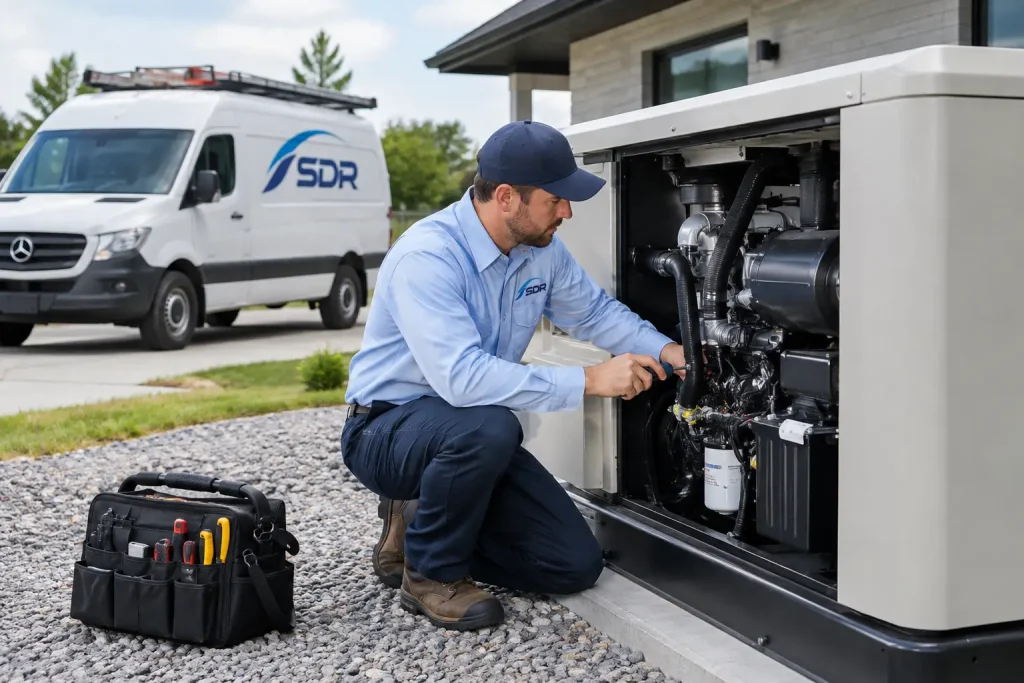
Technicians should inspect for coolant leaks, low fluid levels, soft hoses, worn belts, and restricted radiators or louvers. They should also verify that the exhaust system is secure and properly routed. Exhaust leaks or inadequate ventilation can create serious carbon monoxide and fire hazards, especially where equipment is installed near occupied areas or air intakes.
Protect the fuel supply
Fuel-related problems vary by generator type. Diesel fuel can collect water, grow microbial contamination, or lose quality during long storage periods. Fuel polishing, sampling, tank inspections, and filter replacement may be needed depending on the tank size, age of the fuel, and standby requirements.
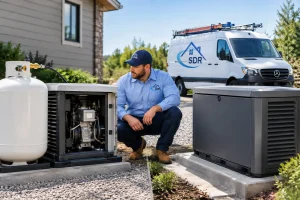
Natural gas and propane generators avoid some diesel storage concerns, but they still depend on an adequate, reliable fuel supply. Changes to gas piping, regulators, appliances, or utility service can affect available fuel pressure. A technician should confirm that the generator can receive the fuel volume it needs while operating under load.
Never treat a fuel smell, visible leak, or low-fuel alarm as a routine nuisance. Isolate the area as appropriate and arrange prompt qualified service.
Test the Generator and the Transfer Switch Together
A generator test is only useful if it proves that backup power will reach the intended equipment. That means the automatic transfer switch, often called the ATS, must be part of the maintenance plan.
During a scheduled exercise, the generator should start, stabilize, and transfer the selected loads as designed. The system should then retransfer safely when normal power returns and complete its cooldown cycle. Staff should note delayed starting, transfer failures, abnormal voltage or frequency readings, overheating, excessive smoke, vibration, or repeated alarms.
No-load exercising is helpful, but it does not tell the whole story. A generator that runs with little demand may reveal problems only when carrying a meaningful load. Depending on the application, a technician may recommend a building-load test or load-bank test. These tests help confirm that the engine, alternator, cooling system, and controls can perform under demand.
Testing also reveals an operational issue that many businesses overlook: load priority. If a generator is asked to carry more equipment than it was designed for, the result can be overload trips, poor voltage stability, or failure to support critical systems. Renovations, tenant improvements, new refrigeration equipment, server upgrades, and HVAC additions can all change the building’s electrical demand. Review generator capacity when the property changes.
Keep Clear Records and Act on Warning Signs
A maintenance log turns routine checks into useful information. Record inspection dates, run hours, fluid levels, battery results, alarm codes, transfer-test results, repairs, and parts replaced. For larger or multi-tenant properties, document which loads are expected to operate during an outage and who is responsible for checking the equipment.
Call for professional service when the generator has difficulty starting, runs roughly, leaks fluid, produces unusual exhaust, shows repeated faults, has a weak battery, or fails to transfer power properly. Do the same after a long outage or extended run event. Equipment that performed for many hours under emergency conditions deserves an inspection before it returns to standby duty.
Avoid opening energized electrical sections, bypassing safety controls, or attempting fuel-system repairs without the proper qualifications. Generator work can involve hazardous voltage, stored energy, hot surfaces, pressurized fuel, and automatic starting. Before service begins, the system must be properly isolated so it cannot start unexpectedly.
Build a Maintenance Plan Around Your Building
A useful maintenance plan is not a generic checklist pulled from a binder. It identifies the generator model, fuel type, transfer switches, critical loads, required testing intervals, emergency contacts, and manufacturer service requirements. It should also account for site conditions such as cold weather, dust, moisture, long idle periods, and equipment installed outdoors.
For properties with electrical, HVAC, plumbing, and backup-power systems that overlap, coordinated service can prevent gaps between trades. For example, a generator serving sump pumps, heating equipment, well pumps, or a mechanical room needs both proper electrical transfer and confidence that the connected equipment is safe to restart during an outage. SDR Electric, Plumbing & Heating can help property owners assess those connected systems and schedule qualified generator maintenance.
A generator is most valuable when nobody has time to troubleshoot it. Keep it inspected, tested, documented, and ready so that when normal power drops, your building can keep doing the work it was designed to do.