A water filter can look like a simple upgrade until you are dealing with iron stains, a sulfur smell, hard-water scale, cloudy water, or a private well with changing test results. Water filter reviews are useful, but the most helpful ones do not start with a star rating. They start with the water coming into the home, the problems the household wants solved, and the maintenance the owner can reasonably keep up with.
For homeowners, a filter that works well in one house may be the wrong fit in another. A countertop unit, refrigerator filter, under-sink system, whole-home carbon filter, water softener, reverse osmosis system, and ultraviolet treatment system all do different jobs. Choosing based on a review alone can leave the main issue untouched.
How to Read Water Filter Reviews More Carefully
A strong review explains what problem the equipment solved. Look for specifics: Was the home on municipal water or a private well? Did the homeowner want better taste, fewer hard-water deposits, reduced sediment, or treatment for a confirmed water-quality concern? Details like these matter more than a general statement that the water “tastes better.”
Pay close attention to how long the system had been in use. A review written the day after installation can describe customer service and initial water taste, but it cannot say much about filter life, pressure loss, reliability, or ongoing maintenance. Reviews written after several months are often more useful because they reveal whether the system remains practical for the household.
It is also worth separating comments about the product from comments about the installation. A capable system can perform poorly if it is installed without proper sizing, bypass valves, drain connections, pressure checks, or attention to the home’s plumbing layout. Conversely, a correctly installed filter cannot remove a contaminant it was never designed to treat.
Start With the Water Problem, Not the Filter Type
The right treatment begins with identifying what is actually in the water. Municipal water and private well water can have very different needs. Even neighboring properties with wells may have different water chemistry due to well depth, geology, plumbing materials, and seasonal conditions.
A water test provides the information needed to make a practical recommendation. Depending on the situation, testing may assess hardness, iron, manganese, pH, sulfur-related odor, sediment, bacteria, nitrates, and other concerns. If there is an immediate change in water color, odor, taste, or pressure, treat that change as a reason to investigate rather than assuming a standard filter will solve it.
For example, a carbon filter can improve chlorine taste and odor in treated municipal water. It may not solve hard-water buildup on fixtures. A water softener addresses hardness minerals, but it is not a substitute for disinfection where bacteria are a concern. A UV system can disinfect properly pretreated water, but it does not remove sediment, hardness, or dissolved minerals. Each piece of equipment has a defined job.
Common concerns and the systems that may help
Sediment is often the first issue to address when water contains visible particles or when a home has frequent cartridge clogging. A sediment filter can protect fixtures, water heaters, softeners, and other treatment equipment, but it must be sized for the household’s flow demand and expected sediment load.
Hard water commonly shows up as white scale on faucets, spotting on glassware, dry-feeling skin, reduced soap lather, and shorter appliance life. A properly sized water softener is usually the more direct solution. It is not simply a drinking-water filter, because it treats water supplied throughout the home.
Iron or manganese can cause staining in toilets, sinks, laundry, and plumbing fixtures. The best approach depends on the type and concentration present, along with pH and other water conditions. This is one reason a test matters. Installing a generic filter without diagnosing the iron can lead to frequent plugging and disappointing results.
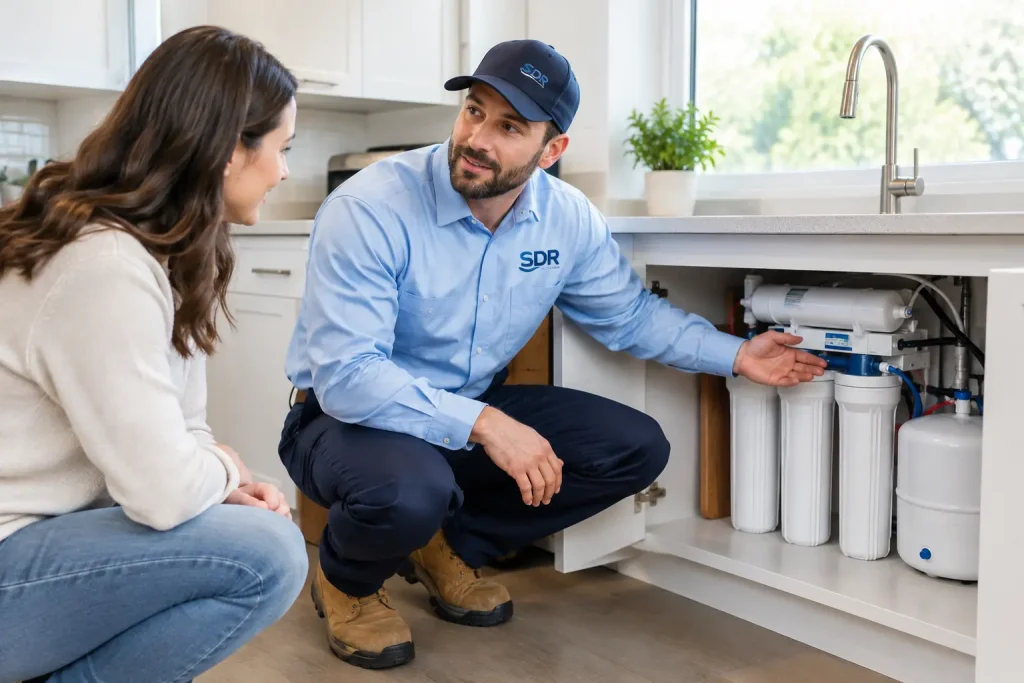
For drinking-water taste and certain dissolved contaminants, an under-sink reverse osmosis system may be appropriate. These systems generally require room under the sink, a drain connection, ongoing filter changes, and adequate water pressure. They are often a good point-of-use option when the goal is improved water at one dedicated tap rather than treatment for every fixture in the home.
Whole-Home Filters Versus Drinking-Water Filters
This is one of the biggest distinctions to make when comparing water filter reviews. A whole-home system treats water as it enters the building. That can benefit showers, laundry, dishwashers, water heaters, and every faucet, depending on the equipment selected. It is usually the better route when the issue affects the entire plumbing system.
A drinking-water filter treats water at one point of use, such as the kitchen sink or refrigerator. It can be an efficient choice when the primary concern is the water used for drinking and cooking. It will not prevent scale in a water heater, stop iron stains in toilets, or improve water used in showers.
There are trade-offs. Whole-home systems need adequate flow capacity so they do not create an annoying pressure drop during busy periods. They also require a suitable installation location, accessible shutoffs, drainage where needed, and space for servicing. Point-of-use systems are less involved, but their benefit is limited to the fixture they serve.
Maintenance Is Part of the Equipment Decision
The best filter is not the one with the longest feature list. It is the one that can be maintained correctly at the required intervals. Every water treatment system has a service requirement, whether that means changing cartridges, replenishing treatment media, cleaning components, replacing a UV lamp, sanitizing equipment, or testing the water again.
Before choosing a system, ask practical questions. How will the household know when service is due? Are replacement components readily available? Can the filter housing be accessed without moving stored items or disconnecting plumbing? Does the unit require power, a drain, or periodic adjustment? A system installed in a cramped, inaccessible area is more likely to be neglected.
For private well owners, maintenance is especially important because water conditions can change. Heavy rain, flooding, well work, pump issues, or changes in taste and odor can all justify follow-up testing. Treatment equipment should be checked as part of the property’s larger water system, alongside the well pump, pressure tank, plumbing, and any softening or disinfection equipment.
What Reviews Can Tell You About Installation Quality
Water filter reviews can reveal a lot about the experience of living with a system, but they should also prompt questions about workmanship. Good installation is not just connecting pipes. It includes confirming water flow direction, using appropriate shutoffs, supporting piping, allowing room for service, protecting against leaks, and verifying that the system does not interfere with existing plumbing equipment.
A whole-home treatment upgrade may also intersect with a pressure tank, well pump controls, water heater, drain routing, or electrical supply. In these cases, coordinated plumbing and electrical knowledge helps avoid piecemeal work and makes future service easier. For homeowners in Leeds and Grenville with private wells or integrated mechanical rooms, this broader view is often more valuable than selecting equipment from a short online description.
At SDR Electric, Plumbing & Heating, water treatment recommendations are approached as part of the home’s complete water system. That means looking beyond the filter itself to identify the cause of the concern and plan an installation that is safe, serviceable, and suited to the property.
Questions to Ask Before You Decide
Before moving ahead, confirm what the system is intended to remove or reduce, what test results support that choice, and whether the equipment has been independently evaluated for its stated purpose. Ask where it will be installed, how it will affect water pressure, what regular maintenance involves, and what signs indicate that service is needed.
If a review praises a system for one particular issue, compare that issue to your own water results. A glowing review from a city-water household may not translate to a rural well. A system that performs well for drinking water may not protect fixtures throughout the house. The right decision is rarely about finding the most talked-about filter. It is about installing treatment that matches the water, the plumbing, and the way the property is used.
When water quality affects your daily routine, a clear diagnosis is more reassuring than a guess. Start with the problem at the tap, test where appropriate, and choose equipment that can do its job reliably long after the first good review.