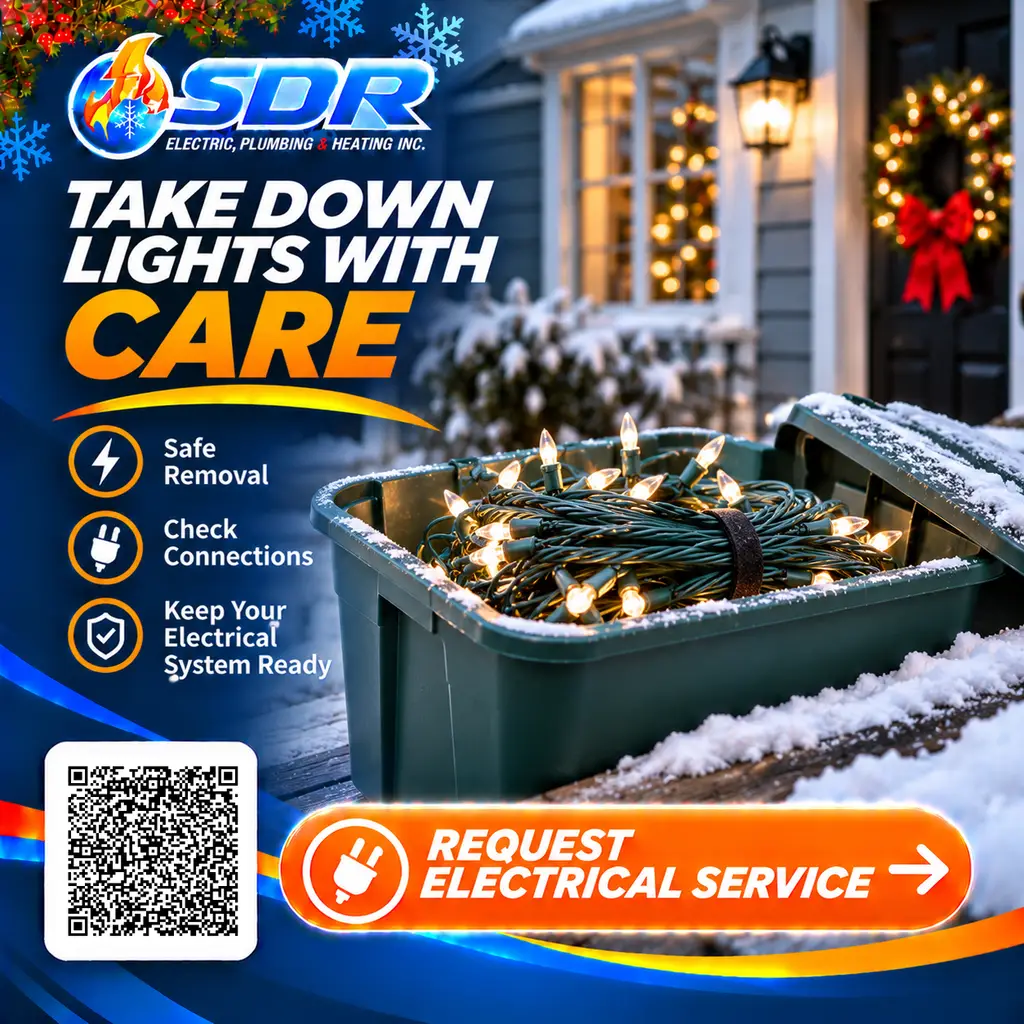
A string of lights that worked perfectly in December can reveal damage once snow, wind, ice, and repeated use have had their say. Knowing what to check when taking down holiday lights helps you avoid a shock hazard now, prevents roof and siding damage, and makes next season’s setup much easier.
For homeowners, this is more than a storage task. Outdoor holiday lighting is exposed to moisture, temperature swings, sharp edges, and extension cords running through busy areas. Take the lights down carefully, inspect what you find, and do not put questionable electrical equipment back into storage.
Start by Shutting Off Power Safely
Unplug holiday lights before removing clips, climbing a ladder, or handling wiring. Turn the lights off first, then unplug them at the outlet or extension cord connection. Do not pull a plug out by the wire, especially if the cord is stiff from cold weather.
If your lights are connected to an exterior outlet with a weatherproof cover, check that the cover and outlet area are dry before disconnecting anything. Outdoor receptacles should have ground-fault circuit interrupter protection, commonly called GFCI protection. If an outlet repeatedly trips, feels warm, looks discolored, or has moisture inside its cover, stop using it until a licensed electrician can inspect it.
Be especially cautious with lights connected near eaves, decks, sheds, or detached garages. These areas often have extension cord connections that were exposed to melting snow or wind-driven rain during the season.
Check Light Strands for Damage Before Storage
It is tempting to coil up every strand and sort it out next year. That can leave damaged equipment sitting unnoticed until the next decorating season, when there is less time and more pressure to get everything working. Inspect each strand as you remove it.
Look closely at the cord insulation. A cord should be discarded if you see cracking, splitting, exposed copper, flattened sections, melted spots, or chew marks from rodents. Damage near plugs and sockets deserves extra attention because those points flex the most and are more likely to loosen over time.
Check the bulbs and sockets as well. Missing bulbs, loose bulbs, broken lenses, corroded contacts, and darkened sockets can point to a problem. With LED strands, a single failed bulb may not stop the whole string from working, but moisture or corrosion inside a socket can still create an unreliable connection.
Do not repair an outdoor light strand with household tape. Tape can trap moisture and does not restore the insulation or strain relief that the cord needs. Replacing a damaged strand is the safer choice.
Examine Plugs, Fuses, and Extension Cords
Most holiday light plugs have small fuses behind a sliding cover. If a strand stopped working during the season, unplug it before checking the fuse compartment. Replace fuses only with the exact type and rating specified for that light set. Installing a larger fuse can defeat the protection built into the plug.
Extension cords need the same inspection as the lights. Check for cracked jackets, bent prongs, loose plug ends, or areas where the cord was pinched under a window, door, deck furniture, or heavy object. Outdoor extension cords should be marked for outdoor use. An indoor cord may look fine after one season outside but may not provide the insulation and moisture resistance needed for exterior conditions.
If you used a power bar outdoors, inspect it carefully. Standard indoor power bars are not designed for wet or damp locations. Outdoor-rated connection boxes and weather-resistant equipment are a safer approach for future displays.
Remove Lights Without Damaging the Home
The condition of your roofline, siding, gutters, and landscaping matters as much as the lights themselves. Remove lights in the reverse order of installation, working from the plug connection back toward the far end of each strand. This reduces tangling and makes it easier to identify which lights belong together.
Use a stable ladder placed on level ground. Have someone nearby to steady the ladder when possible, particularly when working around uneven walkways, snowbanks, or frozen ground. Avoid reaching sideways from a ladder. Climb down and reposition it instead.
Never pull light strands free from the ground or roofline. A stuck strand may be caught in a gutter clip, wrapped around a branch, frozen into ice, or snagged behind siding. Pulling can damage shingles, loosen gutters, tear soffit material, or break a wire inside the cord.
If lights are frozen in place, wait for milder conditions rather than forcing them loose. The same applies to clips that are brittle from cold temperatures. A few extra days of waiting is preferable to damaging roof materials or falling from a ladder.
Inspect Clips, Fasteners, and Roofline Areas
Plastic light clips are designed to hold lights without puncturing your home’s exterior. As you remove them, check for broken pieces left in gutters or attached to shingles. Remove as much as possible so they do not interfere with spring gutter cleaning or become debris in the yard.
If staples, nails, screws, or other penetrating fasteners were used, inspect those locations for damage. Fasteners driven through shingles, siding, fascia, or window trim can create entry points for water. A loose shingle, lifted flashing, damaged siding panel, or cracked trim board is worth addressing before rain and freeze-thaw cycles make the problem worse.
Take a moment to look into accessible gutters while you are already at the roofline. Pine needles, leaves, clips, and light debris can block drainage. Standing water in a gutter can freeze, add weight, and contribute to ice-related damage.
Check the Outdoor Outlet and Electrical Load
Holiday lights often draw less power than homeowners expect, particularly LED displays. Still, the connection point matters. Before putting cords away, inspect the exterior outlet cover, the receptacle face, and the area around it for signs of water intrusion, heat damage, or corrosion.
A brown mark around an outlet, a loose receptacle, a plug that will not stay firmly seated, or a GFCI outlet that will not reset should be treated as a service issue. Do not keep testing a faulty outlet or bypass a tripped GFCI with another power source. The device may be responding to a ground fault, moisture, or damaged wiring.
For larger displays, take note of what worked and what did not. If breakers tripped, connections became warm, or you had to run cords across driveways and walkways, plan a safer arrangement before next season. A properly located outdoor receptacle, weatherproof cover, or dedicated lighting connection can eliminate many temporary-cord problems.
Store Holiday Lights So They Stay Safer Next Year
Once a strand has passed inspection, coil it loosely around a reel, piece of cardboard, or storage organizer. Tight knots and hard bends can stress the wires and make the next installation frustrating. Keep each set together with its extension cord only if both are in good condition and intended for the same use.
Store lights in a dry, protected location away from direct sun, pests, and items that could crush them. A labeled plastic tote is often better than a damp basement corner, unheated shed floor, or loose bag in the garage. Include a simple label such as “front roofline,” “deck railing,” or “outdoor tree” so you can identify each set without untangling every strand next year.
Do not store damaged lights because you intend to repair them later. Separate and dispose of them according to local electronic waste or recycling guidance. Keeping defective cords mixed with working decorations makes it too easy for them to return to service.
When to Call an Electrician
Some holiday-light issues are straightforward, but certain signs point to a problem beyond the decoration itself. Arrange an electrical inspection if exterior outlets trip repeatedly, lights flicker when other appliances run, plugs or receptacles feel warm, you see scorch marks, or you suspect water has entered an outlet or junction box.
Homeowners planning a more permanent seasonal display may also benefit from an upgrade before next winter. SDR Electric, Plumbing & Heating can help assess outdoor electrical access, GFCI protection, weather-resistant equipment, and circuit capacity so seasonal lighting does not rely on overloaded or poorly protected temporary connections.
A careful takedown gives you a safer property now and a cleaner start next season. If something looks worn, wet, hot, or damaged, treat that finding as useful information – not something to pack away and hope for the best.