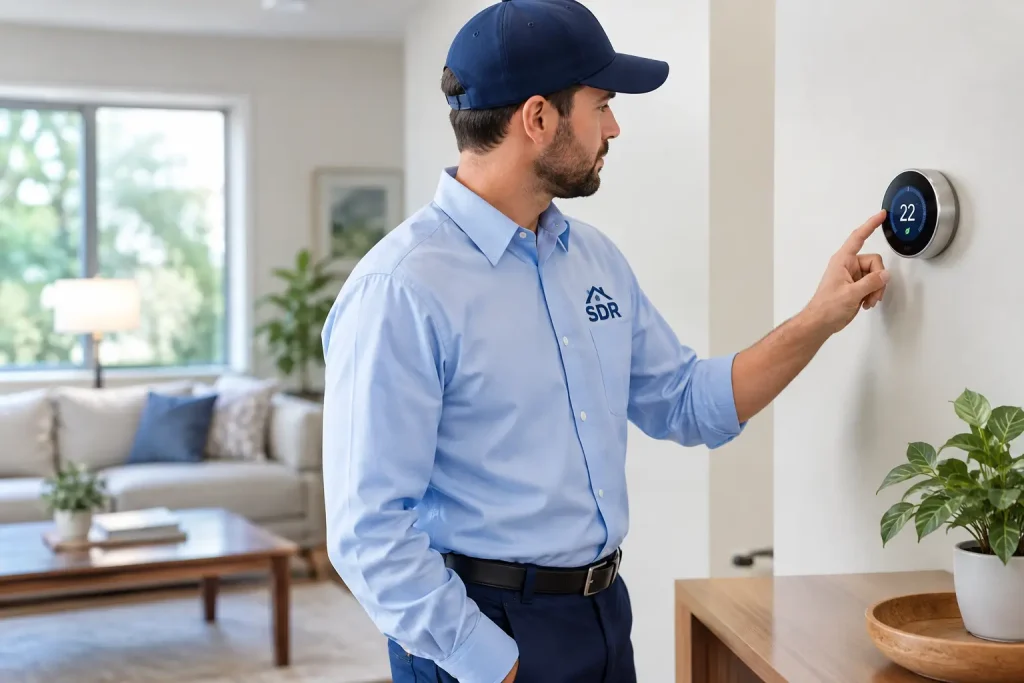
A thermostat should do more than put a temperature on the wall. The best smart thermostat features help your heating and cooling system respond to how your household actually lives: when rooms are occupied, when everyone is away, and when outdoor weather changes quickly. For homeowners, the goal is not more app notifications. It is dependable comfort, sensible energy use, and settings that protect the HVAC equipment you rely on.
A smart thermostat can be a worthwhile upgrade, but only when it is compatible with the equipment in your home and configured correctly. That matters especially for homes with heat pumps, multiple heating stages, central air conditioning, boilers, or connected humidification equipment.
Best Smart Thermostat Features That Matter Most
Flexible scheduling that fits real routines
A reliable schedule is still one of the most useful smart thermostat functions. It lets you set a comfortable temperature for mornings and evenings, then reduce heating or cooling demand when the home is empty or everyone is asleep.
Look for scheduling controls that are easy to adjust by day, rather than a rigid weekday-weekend format. A household with changing work shifts, school activities, or regular travel needs more flexibility than a simple seven-day program. The best systems also make it easy to temporarily override a setting without erasing the entire schedule.
Scheduling works best when it reflects the building itself. A well-insulated home may recover temperature quickly, while an older home with drafts or a slower hydronic heating system may need more time. Large setbacks are not always the right answer. With some systems, pushing the temperature too far down can make recovery less efficient or reduce comfort during the warm-up period.
Remote control with useful notifications
Remote access is practical when it solves a real problem. From a phone, you can check whether the heat was left high while you are away, make an adjustment before arriving home, or confirm that a vacant property is being maintained at a safe temperature.
Alerts can be equally valuable. Many smart thermostats can notify you when indoor temperatures fall outside a chosen range, when the system has been running unusually long, or when the thermostat loses its connection. For a seasonal property, rental unit, or a home left empty during a cold spell, a low-temperature alert may give you time to respond before frozen plumbing becomes a much larger issue.
Alerts are not a substitute for routine maintenance or emergency planning. If a furnace stops producing heat, a notification can make you aware of the problem, but the equipment still requires proper diagnosis and repair. It is also wise to understand what happens during a power outage. The thermostat, Wi-Fi network, and HVAC equipment may not operate normally until power is restored.
Equipment compatibility and staged-system support
This is the feature area that deserves the closest attention. A thermostat must be matched to the type of equipment it controls. A model that works well with a standard furnace and air conditioner may not be appropriate for a heat pump with auxiliary heat, a dual-fuel system, a boiler, or a system with multiple heating and cooling stages.
Staging is especially important. Many high-efficiency furnaces and heat pumps use more than one operating level to maintain steady comfort. A compatible thermostat can call for lower-capacity operation when conditions allow and bring on additional capacity only when needed. When the controls are set incorrectly, the system may cycle too often, fail to use its intended efficiency features, or rely on supplemental heat at the wrong time.
For heat pump homes, proper configuration affects both comfort and operating behavior during cold weather. The thermostat needs accurate settings for the equipment type, available auxiliary heat, and any lockout or changeover controls. This is not a place to guess at wiring labels or menu options. A professional installation helps confirm that the thermostat supports the system and that its settings match the manufacturer’s requirements.
Room sensors for uneven temperatures
A single thermostat measures conditions where it is installed, not necessarily where people are sleeping, working, or spending the evening. In homes with a warm upstairs, a cool family room, or a finished basement that never seems to match the main floor, remote room sensors can make a meaningful difference.
These sensors allow the thermostat to consider temperatures from selected rooms at different times of day. For example, a system can prioritize bedrooms overnight and the main living area in the evening. Some models can average multiple spaces rather than responding to one hallway location.
Room sensors cannot correct every comfort issue. Poor duct design, blocked supply vents, missing insulation, air leaks, or an improperly sized system may still be the underlying cause. They are best viewed as a control improvement, not a repair for a building or HVAC problem that needs attention.
Humidity monitoring and accessory control
Indoor humidity affects how warm or cool a home feels. In winter, air that is too dry can be uncomfortable, while excess moisture can contribute to window condensation and other concerns. In summer, high humidity can make a home feel warmer even when the air conditioner is operating.
Many smart thermostats display indoor humidity, and some can control compatible humidifiers, dehumidifiers, or ventilation equipment. This can be helpful in homes with a whole-home humidifier or systems designed to manage moisture as part of heating and cooling operation.
The key word is compatible. Accessory controls require the right wiring, relays, and setup. If humidity has become a persistent issue, the answer may involve more than thermostat settings. A technician may need to assess ventilation, drainage, ductwork, equipment capacity, or the condition of the humidification system.
Energy reports that lead to better decisions
Energy reports can show runtime patterns, temperature changes, and how weather may affect heating or cooling demand. Used properly, this information helps homeowners spot habits worth changing, such as maintaining an empty home at an unnecessarily high temperature or running cooling longer than expected.
Treat these reports as a guide, not a diagnosis. A sudden rise in runtime can be caused by a cold snap, a heat wave, open windows, an aging filter, or an equipment issue. If the system is running constantly, struggling to maintain temperature, making unusual noises, or producing weak airflow, the concern should be investigated rather than adjusted away in an app.
Features That Depend on Your Household
Geofencing can automatically adjust settings when household members leave or return. It can be convenient, but it is less reliable for homes where people come and go on different schedules, phones are left behind, or pets remain indoors. Many homeowners get better results from a dependable schedule with occasional remote adjustments.
Learning features can also be helpful, but they need a settling-in period and occasional review. If a thermostat keeps making changes that do not suit your routine, turn off the learning mode or limit its automation. The best setup is the one your household understands and can manage confidently.
Voice control is another optional feature. It is useful for quick temperature changes, but it should not be the deciding factor. Compatibility, correct installation, and dependable manual controls matter far more than being able to adjust the temperature from across the room.
Installation Details That Should Not Be Overlooked
Many smart thermostats need a common wire, often called a C-wire, to provide consistent power. Some models offer adapters or alternative power options, but those solutions are not right for every system. Older homes can have limited thermostat wiring, and homes with boilers, heat pumps, or multi-stage equipment may have more complex control requirements.
Before replacing a thermostat, identify the heating and cooling equipment, the number of stages, existing thermostat wires, and any connected accessories. Turn off power to the equipment before handling low-voltage control wiring. Even a small wiring error can cause equipment to operate incorrectly or damage controls.
For a renovation, new build, or HVAC replacement, thermostat planning should be part of the larger mechanical design. Running the right wiring and selecting compatible controls early can prevent avoidable limitations later. SDR Electric, Plumbing & Heating helps homeowners coordinate these details when heating, cooling, electrical, and related mechanical work intersect.
A smart thermostat is most useful when it supports a well-maintained system rather than trying to compensate for one. Choose the features that solve a real comfort or monitoring need, make sure the thermostat fits your equipment, and ask for qualified help when the controls involve heat pumps, staging, or accessory equipment.