A morning shower that turns cold halfway through is more than an inconvenience. It is usually a sign that your household’s hot-water demand has outgrown the equipment serving it. When comparing tankless versus storage water heaters, the right answer depends less on a label and more on how your home uses water, how the system is installed, and what your existing plumbing and electrical or fuel setup can support.
For homeowners, the decision often comes up during a failed water heater, a renovation, or after adding a bathroom, finished basement, or larger household. Both options can provide dependable hot water when they are properly selected and installed. The key is matching the equipment to real conditions in the home rather than choosing based on one feature alone.
Tankless Versus Storage Water Heaters: The Core Difference
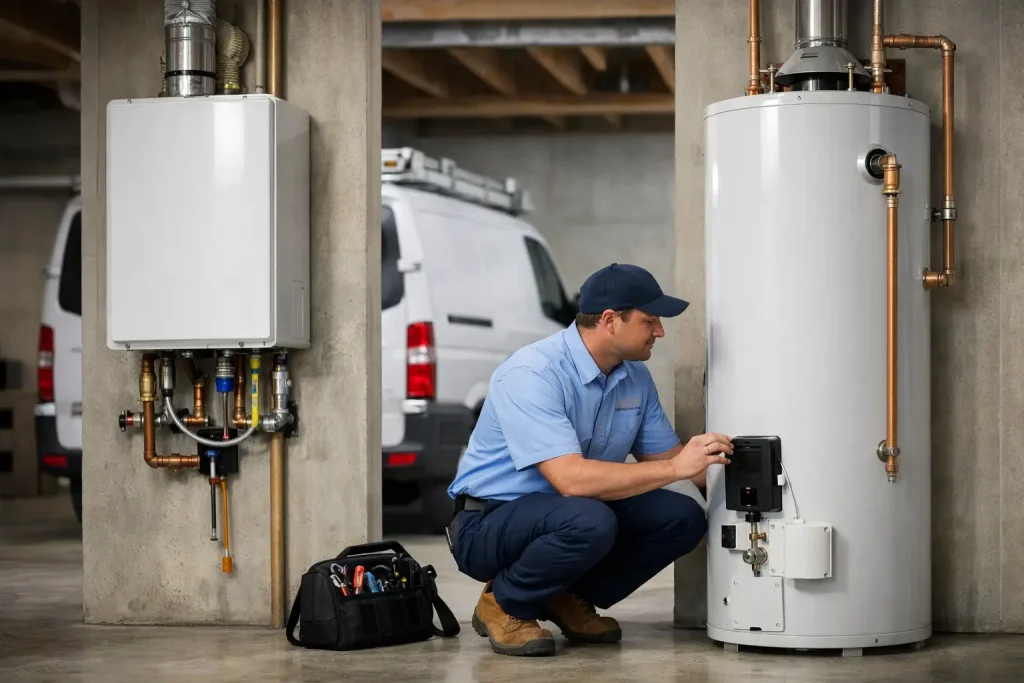
A storage water heater keeps a set amount of heated water in a tank, ready for use. When someone opens a hot-water fixture, water leaves the tank and cold water enters to be heated. The tank has a limited supply at any moment, but a properly sized unit can serve typical household routines reliably.
A tankless water heater heats water as it moves through the unit. It does not store a reserve of hot water, so it can continue producing hot water as long as its capacity is not exceeded. That sounds simple, but the unit’s output depends on the temperature of incoming water and the number of fixtures calling for hot water at the same time.
In Eastern Ontario, cold incoming water matters. During colder months, a tankless unit must raise the water temperature farther before it reaches the shower, faucet, dishwasher, or washing machine. Its available flow rate can be lower than the same unit delivers under warmer incoming-water conditions. This is why sizing should be based on local conditions and simultaneous demand, not just household size.
When a Storage Water Heater Makes Sense
A conventional tank water heater remains a practical choice for many homes. It is familiar, dependable, and well suited to households with predictable routines. A correctly sized tank can handle morning showers, laundry, dishes, and everyday use without requiring occupants to think about which fixtures are operating.
Storage models can also be a good fit when replacing an existing tank in a utility room where the plumbing, venting, drainage, and electrical or fuel connections are already arranged for that style of equipment. A replacement project may still need updates to meet current code and safety requirements, but the overall installation can be more straightforward than changing to a different water-heating system.
The main limitation is recovery time. Once a tank’s stored hot water is used, the system needs time to heat the incoming cold water. A family may notice this after several back-to-back showers or during heavy use. Proper tank sizing reduces that concern, but it cannot create an unlimited supply.
When a Tankless Water Heater Is the Better Fit
Tankless equipment is often appealing to households that need extended hot-water availability. It can be a strong choice for homes with frequent back-to-back showers, large soaking tubs, or schedules where several people use hot water over a long period. Because it heats only when there is demand, it also avoids maintaining a full tank of heated water throughout the day.
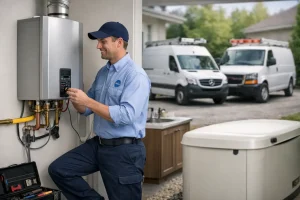
Its compact wall-mounted design can help recover floor space in some mechanical rooms, basements, and utility areas. That can be valuable during a renovation where every square foot matters. However, the smaller appliance does not automatically mean the project itself is smaller. Tankless installations can require changes to venting, combustion air provisions, gas piping, electrical supply, condensate drainage, plumbing layout, or water treatment equipment.
A tankless unit must be sized for peak demand. For example, a shower, kitchen faucet, dishwasher, and laundry appliance running at once may exceed the capacity of a unit that would otherwise work well for one or two fixtures. If output is undersized, users may experience reduced flow, temperature swings, or a system that cannot keep up during busy periods.
Efficiency Is About How Your Home Uses Hot Water
Tankless water heaters can reduce standby energy loss because there is no large tank of hot water being kept ready at all times. That can be beneficial in homes with moderate or uneven hot-water use. The potential benefit is tied to usage habits, not simply the fact that the unit is tankless.
Storage water heaters have standby losses, but modern models are insulated far better than older equipment. For a home with steady daily demand, the difference in energy use may be less dramatic than expected. It is more useful to consider the entire system: how much hot water the household uses, whether occupants are often away, the fuel or electrical setup, and the condition of the home’s plumbing.
There is also a third option worth discussing in some homes: a heat pump water heater. It is still a storage-style system, but it uses heat from surrounding air to warm the tank. Its suitability depends on the mechanical room, available air volume, drainage, electrical capacity, and how the space is used. It is not a direct substitute for every tank or tankless installation, but it can be part of a well-planned upgrade.
Installation Requirements Need a Full-System Review
Water heaters connect to more than hot and cold pipes. They involve safety controls, pressure relief piping, shutoff valves, drainage, venting or exhaust, fuel or electrical supply, and in some cases condensate management. A change from a tank to a tankless model should start with a site assessment, not an assumption that the new unit will fit where the old one stood.
Gas-fired tankless systems may require a larger gas line to deliver adequate fuel during high demand. They also need approved venting and properly planned termination locations. Electric tankless systems can require substantial electrical capacity and may need panel, breaker, or service upgrades. These requirements are especially important in homes that already have electric heating, air conditioning, EV charging, generators, or other major electrical loads.
Water quality also deserves attention. Hard water and mineral buildup can affect any water-heating equipment, but scale can be particularly hard on tankless heat exchangers because water moves through narrow internal passages. If a property uses well water or has known hardness concerns, water testing and appropriate treatment may protect the new equipment and support reliable operation.
Maintenance Is Not Optional for Either Type
Both systems need periodic attention. A storage water heater should be inspected for leaks, corrosion, valve condition, venting concerns where applicable, and sediment accumulation. The area around the unit should remain accessible, dry, and free of stored items that could interfere with service or safety.
Tankless water heaters need regular servicing as well. This commonly includes flushing the heat exchanger to remove mineral scale, checking filters, inspecting venting, and confirming that drainage and safety components are functioning properly. A neglected tankless unit can lose performance even though it does not have a large tank.
The best maintenance schedule depends on the equipment, water quality, and household demand. A licensed plumbing professional can identify the service needs during installation and help prevent a routine maintenance issue from becoming a no-hot-water call.
How to Choose the Right Water Heater for Your Property
Start by looking at peak usage instead of average usage. Think about how many showers may run at once, whether laundry and dishwashing happen during the same period, and whether large tubs or multiple bathrooms are part of the routine. For rental properties and commercial spaces, occupancy patterns and fixture use are just as important.
Next, assess the building systems that support the heater. Available electrical capacity, fuel supply, venting routes, drain access, water quality, room layout, and future renovation plans can all influence the right choice. A tankless unit may be an excellent long-term fit, while another property may benefit more from a properly sized storage system with simpler integration.
Common Questions About Water Heater Types
Will a tankless water heater provide endless hot water?
It can provide continuous hot water within its rated flow capacity. If too many fixtures demand hot water at once, the unit may not maintain the desired temperature or flow. Correct sizing is what makes continuous operation realistic.
Can I replace my old tank with a tankless unit in the same location?
Sometimes, but not always without modifications. The location must support the required connections, venting, drainage, clearances, and electrical or fuel supply. An on-site review identifies what needs to be updated before installation begins.
Is a larger storage tank always better?
Not necessarily. An oversized tank may heat more water than the household regularly needs, while an undersized tank can run short during busy periods. The goal is capacity that matches the home’s actual demand and recovery needs.
Before making a water-heater decision, have the full installation area and your household’s hot-water habits reviewed by a qualified professional. A clear assessment of demand, water quality, and supporting systems will lead to a safer installation and fewer surprises when everyone needs hot water at once.