Hard water often announces itself long before a test confirms it. White buildup gathers around faucets, glassware comes out of the dishwasher cloudy, soap does not rinse cleanly, and fixtures can lose flow over time. For water softener installation Brockville homeowners can depend on, the right starting point is not simply choosing a unit. It is understanding the water source, the household’s actual needs, and how the equipment will connect safely to the plumbing system.
A properly planned softener can protect fixtures, appliances, water heaters, and plumbing components from mineral scale. It can also make daily cleaning easier and improve how soap and detergents perform. But the wrong size, an unsuitable treatment method, or a poor drainage connection can create maintenance headaches that were avoidable from the start.
What a Water Softener Actually Solves
Hard water contains dissolved minerals, most commonly calcium and magnesium. These minerals are not usually a health concern, but they can be hard on a property’s plumbing system. As water is heated or evaporates, minerals are left behind as scale. That scale can build up inside water heaters, on showerheads, around taps, and in appliances that use water regularly.
A conventional ion-exchange water softener removes hardness minerals by passing water through resin beads. During regeneration, the system flushes the collected minerals away and recharges the resin using salt or potassium chloride. The result is softened water delivered to selected plumbing fixtures throughout the building.
Softening is different from filtration. A softener is designed to address hardness, not every possible water-quality issue. If a property has iron staining, sulphur odor, sediment, bacteria concerns, or other well-water conditions, it may need additional treatment equipment. This is why testing matters before equipment is selected.
Water Softener Installation in Brockville Starts With Testing
Municipal and private well water can have very different characteristics, and even neighboring properties can see different results. A water test gives the installer useful information about hardness, iron, manganese, pH, sediment, and other factors that may affect equipment selection and performance.
Hardness alone helps determine the softener’s required capacity, but it is not the only consideration. Iron can foul softener resin if it is not addressed properly. High sediment levels may call for pre-filtration to protect valves and resin. Low pH can point to corrosion concerns that should be evaluated alongside the water treatment plan.
For well-water properties, water treatment should also be considered in the context of the complete water system. The well pump, pressure tank, pressure switch, filtration equipment, drainage route, and electrical supply all play a role. A softener cannot perform consistently if the home has pressure problems, intermittent well-pump operation, or restricted plumbing upstream.
Choosing the Right Type and Size of Softener
There is no one-size-fits-all water softener. System capacity should be matched to the number of people in the home, water use habits, measured hardness, and any iron present in the supply. A system that is too small may regenerate too frequently, while an oversized unit can use more salt and water than necessary.
Modern demand-initiated softeners are often a practical choice for many homes because they regenerate based on water use rather than following a fixed daily schedule. That can reduce unnecessary regeneration when the household is away or using less water. The best option still depends on the water test and the property’s plumbing layout.
Salt-free conditioning systems are sometimes considered by owners who want to avoid salt handling. These systems may help reduce scale formation in certain conditions, but they do not remove hardness minerals in the same way as an ion-exchange softener. They are not a direct replacement where true softened water is needed for laundry, bathing, appliance protection, or significant hardness control.
A single-tank softener is suitable for many residences. Larger households, multi-unit properties, or commercial applications may need a higher-capacity design or a twin-tank arrangement to maintain treated water during regeneration. That decision should be based on real demand, not assumptions.
The Installation Details That Matter
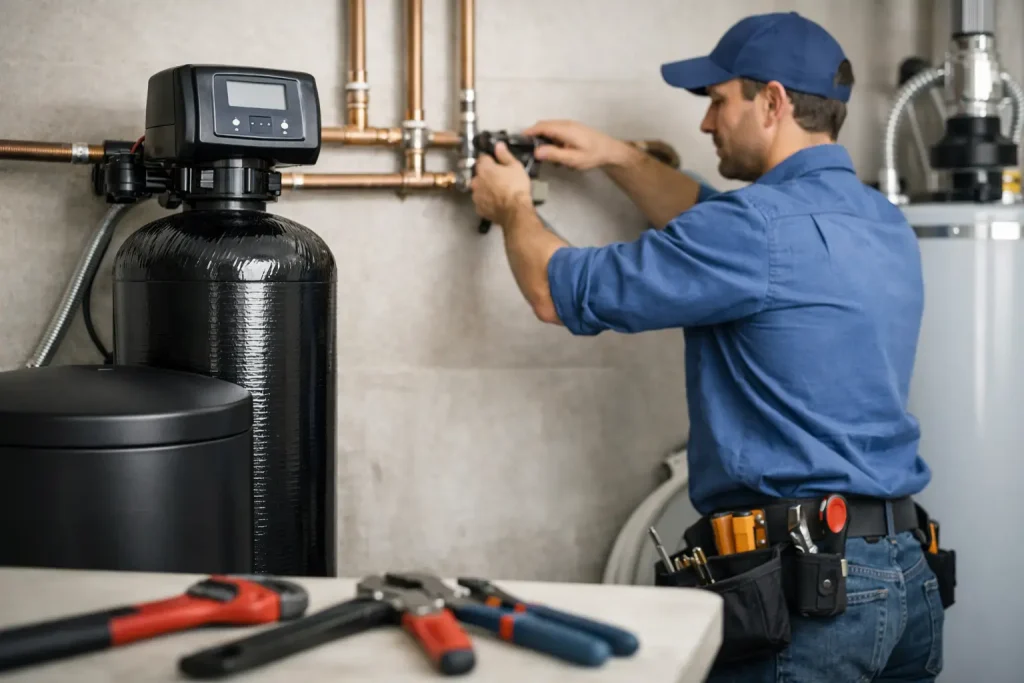
A water softener needs more than a nearby cold-water pipe. A safe, dependable installation requires a planned location with enough space for the mineral tank, brine tank, controls, servicing, and salt loading. The area should be protected from freezing and allow access for routine maintenance.
The system is usually installed after the main water entry point so it can serve the desired fixtures throughout the property. However, some lines may be intentionally left untreated. Outdoor hose connections are often bypassed because softened water is not necessary for lawn or garden use. Depending on the property and local requirements, a kitchen cold-water line may also be left on untreated water or served through a separate drinking-water treatment system.
Drainage is one of the most important parts of the job. During regeneration, the softener must discharge water safely to an approved drain location. The drain line needs proper routing, a suitable air gap where required, and protection from kinks, freezing, or backflow conditions. Sending a drain line into an unsuitable connection can lead to contamination concerns, overflow, or damage.
The installation should also include shutoff valves and a bypass valve. These allow the softener to be isolated for service without shutting down water to the entire home. If there is a leak, control-valve issue, or planned maintenance need, a properly installed bypass makes a meaningful difference.
For homes with electrically operated well equipment, treatment equipment can be part of a broader mechanical-room plan. A qualified local contractor can coordinate plumbing work with well pumps, pressure tanks, sump pumps, electrical upgrades, and backup-power considerations where those systems intersect.
What to Expect During a Professional Installation
Before installation, the technician should confirm the water test results, inspect the existing plumbing, identify an appropriate drain connection, and verify the space around the planned equipment location. They should also look for issues such as corroded piping, limited shutoff access, inadequate water pressure, or a water heater that has already been heavily affected by scale.
Once the system is connected, the resin tank is placed into service, the brine tank is set up, and the control valve is programmed for the property’s water conditions and expected use. The installer should check connections for leaks, verify the regeneration cycle and drain operation, and explain the bypass valve, salt use, and basic maintenance requirements.
Clear communication is especially valuable when water treatment is part of a renovation or a new build. Locating the unit early can prevent crowded mechanical rooms, inaccessible valves, awkward drain routing, and future service difficulties. SDR Electric, Plumbing & Heating Inc. can coordinate water-treatment plumbing with the related electrical and mechanical work so the system is planned as part of the property, not added as an afterthought.
Maintenance Keeps Soft Water Consistent
A water softener is not maintenance-free, but routine care is straightforward. Keep the brine tank supplied with the recommended salt, avoid letting it sit empty for long periods, and watch for salt bridging – a hardened layer that can form above the water level and prevent salt from dissolving properly.
The resin and control valve also benefit from periodic professional inspection, particularly when a home is supplied by a well. Changes in water quality, new staining, unusual odor, a drop in water pressure, or water that suddenly feels hard again can all indicate that the system needs attention. Sometimes the softener is the issue; other times the source is a clogged pre-filter, a pressure-tank problem, or a change in well-water conditions.
When a Softener May Not Be the Only Answer
If orange staining appears in toilets and sinks, iron may be present at a level that requires dedicated iron treatment. If water smells like rotten eggs, sulphur treatment may be needed. Cloudy water, visible grit, or recurring filter blockage can indicate sediment that should be managed before water enters the softener.
For drinking-water concerns, a separate point-of-use filtration system may be appropriate at the kitchen sink. Water treatment works best when each issue is identified and addressed with the right equipment rather than expecting one appliance to solve every condition.
A water softener should make your plumbing easier to live with, not add another source of uncertainty. Start with a proper water assessment, plan the drain and bypass connections carefully, and choose equipment sized for the way your property actually uses water.