Hard water rarely announces itself with one dramatic problem. More often, it shows up as white buildup on faucets, cloudy glasses, stiff laundry, dry skin, soap that will not lather well, or an appliance that seems to need attention too soon. Knowing how to choose a water softener starts with identifying what is actually in your water, then selecting equipment that fits your household, plumbing, and ongoing maintenance expectations.
For homeowners on a private well or municipal supply in Eastern Ontario, a water softener can be a practical long-term upgrade. However, a softener is not a catch-all water treatment system. The right choice depends on hardness levels, water use, iron or manganese content, available installation space, drainage, and the condition of your existing plumbing.
Start With a Water Test, Not a Guess
A water softener is designed primarily to reduce hardness minerals, especially calcium and magnesium. Those minerals are responsible for scale buildup inside water heaters, fixtures, pipes, dishwashers, and other water-using equipment. But similar symptoms can also be caused by iron, sediment, sulfur odors, low pressure, or aging plumbing components.
A proper water test gives you a starting point. At minimum, it should identify water hardness. If you use well water, testing for iron, manganese, pH, sediment, and bacteria may also be appropriate. These results determine whether a standard softener is suitable or whether the system needs pretreatment.
For example, moderate iron may require an iron-reduction filter ahead of the softener. High sediment can shorten the life of valves and media if it is not addressed first. A rotten-egg odor often points to sulfur or bacteria, which requires a different treatment approach than hardness alone. Installing a softener without understanding these conditions can leave the original water problem unresolved.
Understand What a Water Softener Does
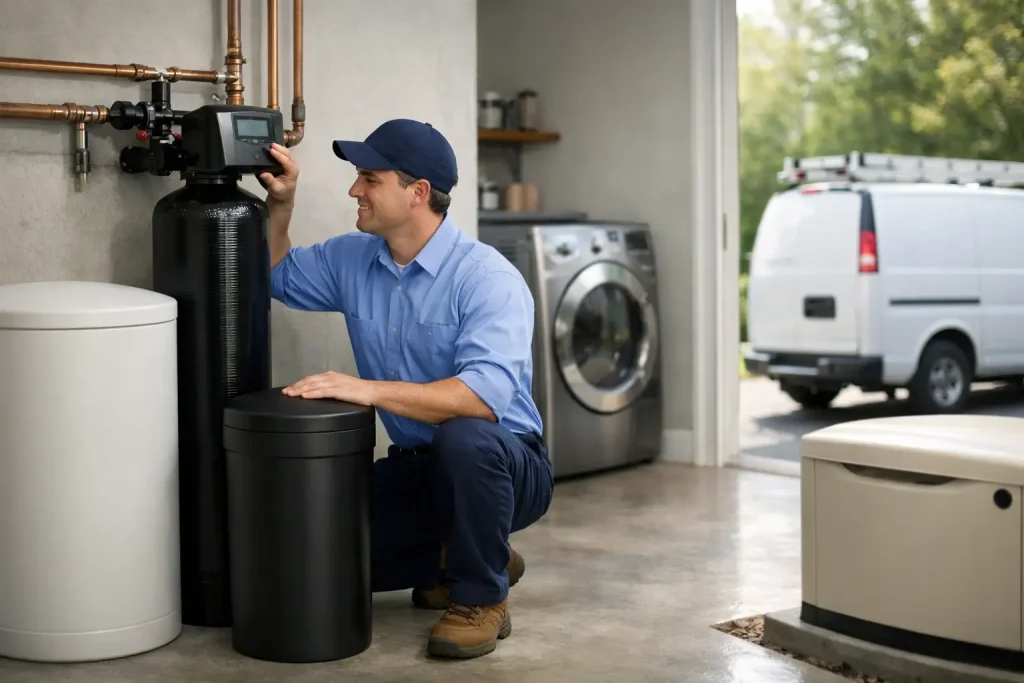
Most residential water softeners use ion exchange. Hardness minerals are removed as water passes through resin beads inside the tank. The system periodically regenerates by flushing the collected minerals away using a salt solution from the brine tank.
This process can reduce scale and improve how soap, detergent, and shampoo perform. It can also help protect water-using equipment from mineral buildup. That matters for homes with tank-style or tankless water heaters, washing machines, dishwashers, humidifiers, and plumbing fixtures that are exposed to hard water every day.
A softener does not usually remove bacteria, all sediment, chemical contaminants, or every source of unpleasant taste and odor. If drinking water quality is your main concern, you may need a separate filtration system at the kitchen sink or another point of use. The goal is to match each treatment device to a verified water condition rather than expecting one unit to do every job.
How to Choose a Water Softener Size
Capacity is one of the most important decisions. A system that is too small will regenerate too often, using more salt and water than necessary. A system that is too large for the household may take up extra space and may not operate as efficiently under lower water use.
Softener capacity is commonly described in grains. The correct capacity depends on your water hardness and the amount of water your household uses. A larger family, multiple bathrooms, frequent laundry, and high-demand fixtures all increase daily water use. Homes with very hard water may also need more capacity, even with fewer occupants.
A qualified plumbing professional can calculate expected hardness loading based on test results and household demand. This is more reliable than choosing a unit based only on the number of people in the home. Household habits matter. Two adults who work from home, run a busy laundry schedule, and have a large soaking tub may use considerably more water than a larger household with lower daily demand.
Consider Peak Flow Rate Too
Capacity tells you how much hardness a softener can handle between regeneration cycles. Flow rate is different. It affects how well the system keeps up when several fixtures are running at once.
If the softener cannot meet peak demand, water may pass through too quickly to be treated effectively. This can be noticeable in homes with multiple showers, large tubs, high-flow fixtures, or irrigation and household water use occurring at the same time. A properly sized system should support both the home’s expected daily demand and its busiest periods.
Choose the Right System Type
A conventional salt-based ion-exchange softener remains the most effective option for removing hardness minerals. It is generally the best fit when scale control and softer water are the primary goals.
Salt-free systems are sometimes marketed as water conditioners. They may alter how minerals behave and can help reduce scale in some conditions, but they do not remove hardness in the same way as an ion-exchange softener. They can be a reasonable option for certain homes, especially where salt use is a concern, but expectations should be clear before installation.
You will also need to decide between a single-tank and twin-tank configuration. A single-tank system is common for many households and regenerates on a scheduled or demand-based cycle. A twin-tank system can provide a more continuous supply of softened water, which may suit larger homes or properties with high and steady water demand.
Demand-initiated regeneration is often a practical feature to look for. Rather than regenerating strictly on a timer, the system tracks water use and regenerates when its treatment capacity has been used. This can reduce unnecessary salt and water consumption while helping maintain consistent performance.
Plan for Installation Conditions
The best equipment still needs a suitable installation location. Water softeners are commonly placed near the main water entry point, often in a basement, utility room, mechanical room, or well equipment area. The system should treat the home’s domestic water supply while leaving certain connections, such as outdoor hose bibs, unsoftened when appropriate.
Before choosing a unit, confirm that the area has enough room for the resin tank, brine tank, shutoff valves, bypass piping, and future servicing. The system also needs access to a proper drain for regeneration discharge and an electrical outlet for the control valve. Drain connections must be installed correctly to prevent backflow and avoid damage to the plumbing system.
If your home has a septic system, consider the added water from regeneration cycles as part of the overall plan. The impact depends on system size, regeneration frequency, and site conditions. A correctly sized demand-initiated unit can help avoid unnecessary regeneration, but it should still be discussed during the installation assessment.
Older homes may need additional plumbing work before a softener can be installed safely. Corroded shutoff valves, restricted piping, poor drainage arrangements, or an undersized pressure tank can affect performance. If low water pressure is already a concern, it is worth identifying the cause before assuming the softener is the solution.
Think About Salt, Maintenance, and Access
A water softener is not maintenance-free. Salt-based systems need salt added to the brine tank, and the frequency depends on household water use, hardness, and equipment settings. Keeping the correct salt level helps the unit regenerate properly.
The brine tank should be checked periodically for salt bridging, a hardened layer that can form above the water and prevent salt from dissolving correctly. Resin, valves, and filters also need periodic inspection. If the water contains iron or sediment, maintenance needs may be greater unless pretreatment is installed.
Choose a system that you can access comfortably. A unit tucked into an unfinished corner may be out of sight, but it should not be so difficult to reach that basic checks are ignored. Installation should leave enough clearance for filling the brine tank, servicing the valve, and inspecting plumbing connections.
Know When a Professional Assessment Helps
Choosing a water softener becomes more complicated when a property has a well, visible staining, recurring pressure problems, an aging water heater, or plans for a renovation. These issues can overlap. A new softener may protect fixtures and equipment, but it should be coordinated with filters, well pumps, pressure tanks, plumbing upgrades, and drainage where needed.
A professional assessment can confirm water conditions, size the system, review the installation area, and identify related plumbing concerns before work begins. SDR Electric, Plumbing & Heating can help homeowners plan water treatment as part of a broader plumbing or mechanical-room upgrade, rather than treating it as an isolated appliance installation.
The right water softener should quietly support the rest of your home. When it is matched to your actual water quality and installed with the right plumbing connections, you should spend less time scrubbing mineral buildup and more time simply using your water with confidence.