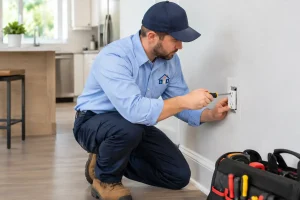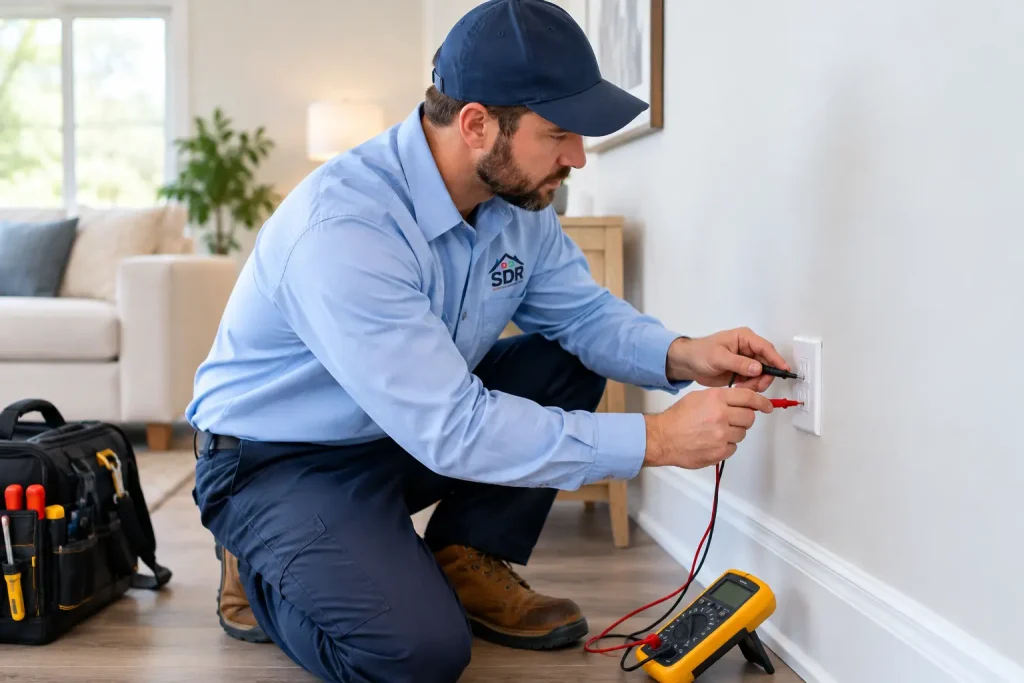
A lamp that flickers, a receptacle that will not charge a phone, or a breaker that trips without an obvious reason can all point to an outlet problem. Knowing how to test outlet voltage can help you confirm whether power is reaching the receptacle before you move a heavy appliance, replace a device, or arrange service. It also needs to be done carefully: outlet testing involves energized wiring, and a wrong move can cause shock, burns, or equipment damage.
For most homeowners, a basic reading is useful information, not a license to work inside the electrical box. If you find unusual voltage, heat, damaged wiring, or repeated breaker trips, stop there and have a licensed electrician diagnose the circuit.
What You Need to Test Outlet Voltage
A digital multimeter rated for electrical work is the right tool for this job. Use a meter with insulated probes in good condition and a voltage rating appropriate for household circuits. Do not use probes with cracked insulation, loose metal tips, or damaged leads.
Set the meter to AC voltage, often marked as V with a wavy line. If your meter is not auto-ranging, select a range above 120 volts. On a typical North American household receptacle, you are checking for approximately 120 volts. Actual readings can vary modestly depending on the utility supply and electrical load in the home.
Before testing an outlet, inspect it without touching the slots. A cracked cover plate, loose receptacle, scorch mark, buzzing sound, burning smell, or warm faceplate is a reason not to test it yourself. Turn off the circuit if you can do so safely, keep people away from the area, and arrange professional electrical service.
How to Test Outlet Voltage With a Multimeter
Start by confirming that your multimeter works. If possible, test a known working receptacle first. Plug the probes into the correct meter ports: the black probe goes into the COM port, while the red probe goes into the port marked for voltage. A common error is leaving the red probe in the high-amperage port, which can damage the meter or create a hazard when checking voltage.
Keep your fingers behind the probe guards at all times. Hold one probe in each hand only by the insulated handles. Do not let the metal probe tips touch each other while they are inserted in an energized outlet.
Check Hot to Neutral
On a standard 120-volt duplex outlet, the narrow slot is hot and the wider slot is neutral. Carefully insert the black probe into the wider slot and the red probe into the narrower slot. Do not force either probe or push it past the point needed for a reliable contact.
A normal reading is generally close to 120 volts. A reading somewhere around 110 to 125 volts may be normal under typical conditions, although a qualified electrician should assess consistently low or high voltage, especially if lights dim, motors struggle, or sensitive electronics are affected.
If the meter reads zero or close to zero, the outlet may have no power, the probes may not be making contact, or there may be a wiring fault. First, check whether the breaker is on and whether a GFCI outlet elsewhere has tripped. Do not repeatedly reset a breaker or GFCI that trips again.
Check Hot to Ground
Next, place the black probe in the round grounding hole and the red probe in the narrow hot slot. This reading should be close to your hot-to-neutral result, usually around 120 volts.
If you have voltage from hot to neutral but little or no voltage from hot to ground, the grounding path may be compromised. That does not always mean the receptacle itself is the only issue. The problem can be upstream in another outlet, a junction box, or the circuit wiring. A missing or failed ground is a safety concern, particularly in kitchens, bathrooms, garages, basements, and outdoor locations.
Check Neutral to Ground
Finally, place one probe in the wide neutral slot and the other in the round ground opening. This should read close to zero volts. A very small reading can occur, but a significant voltage between neutral and ground can indicate a loose neutral, incorrect wiring, or another circuit issue that needs professional troubleshooting.
Remove the probes one at a time, without touching the exposed metal ends. Turn your meter off when finished and store it where the leads will not be damaged.
What Common Voltage Readings Can Mean
A meter reading is a clue, not a complete diagnosis. The condition of the circuit, what else is running, and the type of receptacle all matter.
A reading near 120 volts from hot to neutral and hot to ground, with close to zero volts from neutral to ground, usually indicates that power and basic polarity are present. It does not guarantee that the outlet is mechanically secure or that the circuit is sized correctly for every appliance.
No voltage at all may mean a tripped breaker, tripped GFCI protection, a switched outlet, a failed receptacle, or an open connection upstream. In some rooms, one half of an outlet is controlled by a wall switch, so check both receptacles before assuming there is a fault.
Low voltage can show up when a major appliance starts, but it should not be a persistent condition. Loose connections, overloaded circuits, corroded connections, or supply issues can cause voltage drop. If lights noticeably dim when the furnace, pump, or air conditioner starts, it is worth having the electrical system checked.
A reading substantially above the expected range also needs attention. High voltage can shorten the life of electronics and appliances. Do not attempt to correct it at the outlet or panel yourself.
Special Cases: GFCI, 240-Volt, and Smart Outlets
GFCI outlets have TEST and RESET buttons and are commonly installed where moisture is present. If a GFCI will not reset, unplug everything on that circuit first and try once more. If it still will not reset, leave it alone. It may be sensing a downstream fault, moisture, damaged wiring, or a failed device.
Dryers, ranges, EV chargers, shop equipment, and some HVAC equipment can use 240-volt circuits. These outlets have different slot configurations and testing methods. Because they may have more than one energized hot conductor, do not apply the standard 120-volt outlet procedure to them unless you understand the equipment and are qualified to test it. A licensed electrician should handle unexplained 240-volt outlet issues.
USB, smart, and tamper-resistant receptacles can also behave differently from a basic outlet. A charging port failure does not necessarily mean the receptacle has lost power. Test the standard plug openings, if present, and avoid inserting probes into USB ports or specialty connections.
When to Stop and Call an Electrician
Testing is not the right next step in every situation. Stop and call for help if you notice any of the following:
- A hot, loose, discolored, buzzing, or sparking outlet
- A breaker or GFCI that repeatedly trips or will not reset
- A reading that is far outside the expected range
- Voltage that disappears when an appliance is plugged in
- Water exposure near an outlet, panel, or electrical equipment
- Aluminum wiring, damaged cables, or visible burned insulation
These signs can point to loose connections and overheating inside the wall, not just a worn receptacle. Replacing the outlet without finding the source can leave the hazard in place.
For homeowners in Brockville and throughout Leeds and Grenville, SDR Electric, Plumbing & Heating can trace outlet faults, correct wiring issues, replace damaged devices, and assess whether a circuit upgrade is needed. A proper diagnosis looks beyond the one outlet to the breaker, connected devices, load on the circuit, and the condition of the wiring behind the wall.
A multimeter can tell you whether an outlet appears to have power, but a safe electrical system depends on more than one number on a screen. When the reading does not make sense or the outlet shows signs of damage, leaving the repair to a licensed professional is the practical next step.