A smoke alarm that is missing, silent, or installed in the wrong location can leave a household with very little warning during a fire. Smoke detectors are one of the simplest safety systems in a home, but they only do their job when they are correctly selected, placed, powered, and maintained. For homeowners, landlords, and property managers, a few practical checks can make a meaningful difference.
Why smoke detectors need more than a quick battery check
Most people think about smoke alarms only when one starts chirping in the middle of the night. A low-battery warning is worth addressing right away, but battery condition is only one part of the system. Age, placement, wiring, dust buildup, paint, and the type of sensor all affect whether an alarm can provide early warning.
Smoke spreads quickly and can make escape routes unusable before flames are visible. Early notification gives people time to get out, call emergency services, and avoid trying to investigate a dangerous situation. This is especially important in homes with bedrooms on separate floors, finished basements, attached garages, or occupants who may not wake easily.
A dependable setup is not just about meeting a requirement during a renovation or inspection. It is about making sure every sleeping area has the best possible chance of receiving an alarm when it matters.
Where should smoke detectors be installed?
Proper placement is often more valuable than adding alarms randomly. Requirements can vary by local building code, the age of the home, and the scope of renovation work, but the general safety approach is clear: alarms should protect sleeping areas and every level of the home.
Smoke alarms are commonly installed inside each bedroom, outside sleeping areas, and on every story of the house, including the basement. In a larger home, hallway layouts, open stairwells, and long distances between bedrooms may call for additional devices. A detached garage, workshop, or accessory building may also need its own appropriate detection and alerting plan.
Ceiling placement is often preferred because smoke rises, though manufacturer instructions should always guide the final location. Devices should be kept away from air supply registers, ceiling fans, windows, and other spots with strong airflow that may delay smoke reaching the sensor. Avoid placing a smoke alarm too close to cooking appliances, showers, or laundry areas when steam and normal household activity are likely to cause nuisance alarms.
A frequently silenced or removed alarm is not solving the problem. If cooking smoke regularly triggers an alarm, the answer may be better placement, ventilation improvements, or the right alarm type for that location. It should never be disabling a safety device.
Smoke alarms and carbon monoxide alarms serve different jobs
Smoke alarms detect signs of fire. Carbon monoxide alarms detect an odorless gas created by incomplete combustion. One does not replace the other.
Homes with fuel-burning appliances, fireplaces, attached garages, or generators need careful carbon monoxide protection as well. Combination units are available, but they must still be located and maintained according to their instructions and applicable code. A professional can help determine whether existing devices cover both hazards properly, particularly after a furnace replacement, electrical upgrade, basement finish, or renovation.
Choosing the right type of alarm
The alarm aisle can feel more complicated than it should. The key differences usually come down to sensor technology, power source, and interconnection.
Photoelectric alarms are generally effective at detecting smoldering fires that may produce larger smoke particles over time. Ionization alarms have historically responded well to fast-flaming fires. Many homeowners choose dual-sensor alarms, or use an appropriate combination of technologies, to provide broader coverage. Follow current product guidance and local requirements when making a selection.
Power supply matters just as much. Battery-operated alarms can be useful in certain locations and are common in older homes, but hardwired alarms with battery backup offer an additional level of reliability. When power is available, interconnected alarms are often the better safety choice. If one alarm activates, the other connected alarms activate as well, helping ensure a fire in the basement or garage is heard upstairs in a bedroom.
Interconnection may be accomplished through hardwired connections or approved wireless technology, depending on the equipment and building conditions. The best option depends on the home’s wiring, age, renovation plans, and code obligations. A qualified electrician can assess the system instead of treating each alarm as a separate device.
How to test and maintain smoke detectors
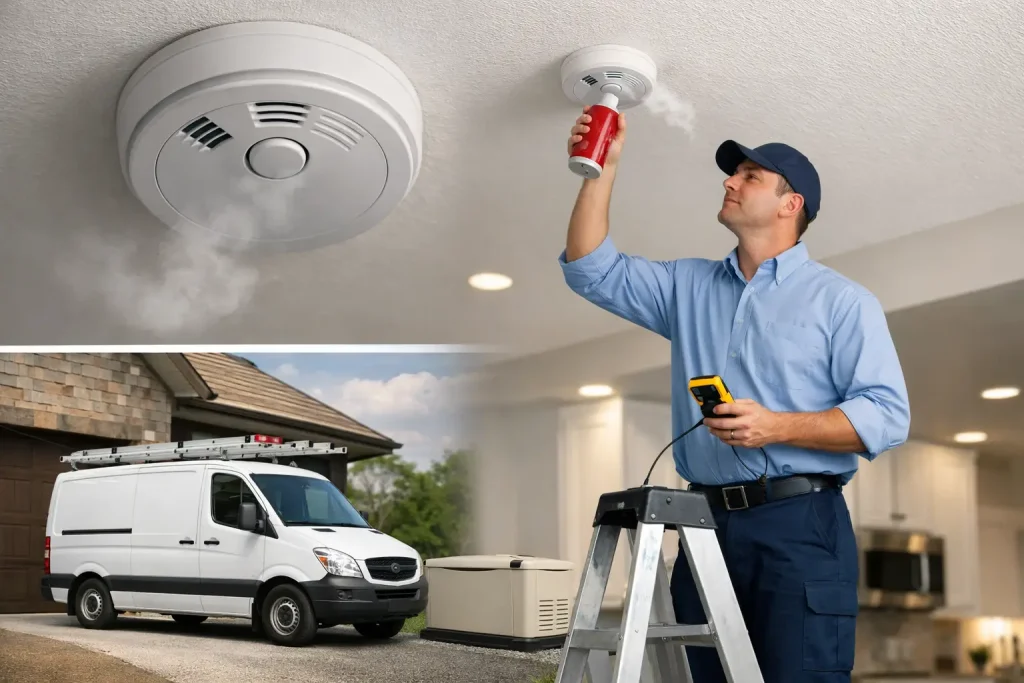
A regular test takes only a few moments. Press and hold the test button on each alarm until it sounds. In an interconnected system, confirm that the other connected alarms activate too. If they do not, the problem may involve wiring, a failed device, a communication issue, or improper installation.
A useful routine is to test alarms monthly and to make the check part of another recurring household task. For rental properties, documented inspections are a practical way to support safety and maintenance responsibilities.
Keep the alarm exterior clean by gently vacuuming around the openings with a soft brush attachment, following the manufacturer’s instructions. Dust, insects, cobwebs, and construction debris can interfere with performance or create false alarms. Never paint over an alarm, tape over openings, or place decorative covers around it.
Battery replacement depends on the device. Some alarms use replaceable batteries, while others have sealed long-life batteries. Do not assume a sealed battery means the entire unit lasts forever. Smoke alarms have a limited service life, and many models should be replaced after about 10 years. Check the manufacturing date printed on the back of the device and follow the manufacturer’s replacement guidance.
If an alarm chirps after a fresh battery is installed, do not ignore it. It may be signaling end of life, contamination, a poor battery connection, or a wiring issue. Resetting it may solve a minor fault, but repeated chirping deserves investigation.
When an electrician should inspect the system
Some smoke alarm tasks are straightforward, such as testing a device or replacing a battery. Others should be handled by a licensed professional, particularly when the issue involves hardwired equipment, new circuits, interconnection, or renovation-related code requirements.
An electrical assessment is a sensible next step when alarms do not all sound together, hardwired alarms lose power, a device activates without an obvious cause, or a renovation changes bedroom layouts and living spaces. A professional should also be involved when adding alarms to a finished basement, converting a space into a bedroom, completing an addition, or updating an older electrical system.
For a new build or major renovation, smoke and carbon monoxide alarms should be planned alongside the electrical layout rather than added at the end. Device locations, circuit connections, backup power, and interconnection all work better when considered early. SDR Electric, Plumbing & Heating Inc. can coordinate this work with electrical upgrades and broader renovation systems so safety devices are not treated as an afterthought.
Common mistakes that reduce protection
The most common problem is relying on too few alarms. One detector near the kitchen does not provide adequate warning for bedrooms on another level or at the far end of the home. Another mistake is assuming an alarm that has not chirped must be working. Testing is the only practical way to know whether it can sound.
Homeowners also sometimes remove batteries after nuisance alarms, especially during cooking. That leaves the home unprotected and can create a serious liability issue in a rental property. Address the cause instead. Improve kitchen ventilation, review alarm placement, and consider whether the installed unit is appropriate for the area.
Finally, do not overlook alarm age. An older unit may appear normal but have a sensor that is no longer dependable. When the replacement date arrives, replace the device rather than stretching its service life.
A well-maintained alarm system is quiet most of the time, which is exactly the point. Set a monthly reminder, check the dates on every unit, and deal with a chirp or fault before it becomes the only warning your household does not receive.