A failed sump pump, a no-heat call, or a panel upgrade is rarely a textbook problem. Conditions on site, previous repairs, building age, and the way electrical, plumbing, and HVAC systems interact all affect the right solution. That is why mentorship matters in the skilled trades: it helps newer technicians turn training into safe, sound decisions when real properties do not follow a script.
For homeowners, property managers, and builders, mentorship may happen behind the scenes. But its effects are visible in the quality of a diagnosis, the care taken around a home, the clarity of the explanation, and whether a repair is built to last. A strong trade workforce is not developed by handing someone tools and hoping experience fills the gaps. It is developed through supervised work, honest feedback, and experienced people teaching the judgment that manuals alone cannot provide.
Skilled-trade mentorship builds safer decisions
Licensing, formal education, and code knowledge are essential. They establish the foundation for safe work. Mentorship adds something different: the ability to recognize risks before they become incidents.
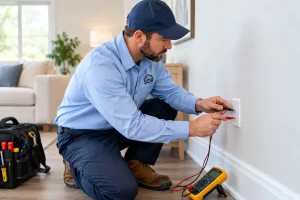
An experienced electrician can show an apprentice why a circuit needs to be tested and verified before work begins, not merely explain the procedure. A plumber can point out the signs that a small leak may have caused hidden damage. An HVAC technician can teach a newer team member to look beyond a tripped safety switch and identify the operating condition that caused it to trip.
This kind of instruction is especially valuable because trade work involves changing environments. A renovation may uncover outdated wiring. A well-pump issue may involve electrical controls, pressure equipment, plumbing connections, and water conditions. A generator installation may affect fuel supply, transfer equipment, electrical loads, ventilation, and local requirements. The job is safer when a less-experienced technician has a knowledgeable person nearby to explain what to inspect, what to stop and question, and when a broader assessment is needed.
Mentorship is not a substitute for procedures or qualifications. It reinforces them through repetition and accountability. The goal is to make safe habits automatic, even when the call is urgent or the work area is difficult.
Why mentorship matters in the skilled trades for customers
Customers generally do not see the conversations that happen between a senior technician and an apprentice. They do see whether the people at their door are prepared, organized, and respectful of the property. Good mentorship connects directly to that experience.
A mentor teaches more than installation methods. They teach how to listen when a homeowner says the water pressure changed gradually, the basement only gets damp during heavy rain, or the furnace starts but never seems to satisfy the thermostat. Those details can change the diagnostic path. Rushing past them can lead to a repair that addresses a symptom but not the cause.
Clear communication is another learned skill. Technical information needs to be accurate without making the customer feel overwhelmed. A well-mentored technician learns to explain what was found, what it means, what work is recommended, and what factors may affect the final scope. That approach gives property owners practical information without speculation or pressure.
For commercial clients and contractors, mentorship supports consistency across the job site. It helps teams understand how their work affects the next trade, the project schedule, and the building owner’s long-term maintenance needs. In a mechanical room, for example, neat routing, accessible shutoffs, proper labeling, and coordinated equipment placement can prevent service headaches years after construction is complete.
Experience teaches troubleshooting, not just task completion
Many trade tasks have clear steps. Replace a fixture. Install a receptacle. Service a drain. Set a thermostat. Those steps matter, but troubleshooting demands a deeper level of thinking.
A technician might find a breaker that has tripped repeatedly. Resetting it may restore power temporarily, but it does not explain why the breaker opened. The underlying issue could be an overloaded circuit, damaged wiring, a failing appliance, moisture intrusion, or another fault. Learning to work through those possibilities methodically is one of the strongest benefits of mentorship.
The same is true with heating and plumbing concerns. Low water pressure could stem from a clogged filter, a failing pressure tank, a partially closed valve, a treatment-system issue, or a well-related problem. An air conditioner that runs constantly may involve airflow, insulation, controls, refrigerant, equipment sizing, or more than one of these conditions. Experienced mentors teach technicians to test assumptions, verify results, and avoid treating every familiar symptom as the same problem.
That discipline protects customers from incomplete repairs and helps teams use their time responsibly. It also builds confidence in newer technicians without pushing them to pretend they have seen every situation before.
Good mentors teach judgment and ownership
The best mentors do not simply provide answers. They explain their reasoning, ask questions, and give newer team members appropriate responsibility with support close at hand.
There is a balance to strike. Too little supervision can leave an apprentice unsure or lead to avoidable mistakes. Too much control can prevent learning. Effective mentorship gradually expands responsibility as skills develop, while keeping safety and quality standards firm.
This process creates ownership. A technician learns that workmanship includes what happens after the visible repair: checking operation, cleaning the work area, documenting findings, explaining maintenance needs, and making sure the customer knows what to watch for. These details are not extras. They are part of dependable service.
Mentorship also teaches the value of asking for help. In the trades, no one benefits when someone guesses at an unfamiliar condition. A team culture that welcomes questions is safer than one that treats questions as weakness. Complex properties often require several perspectives, especially when electrical, plumbing, heating, cooling, and backup-power systems overlap.
It strengthens the local trade workforce
Skilled trades depend on people choosing the work, developing their abilities, and staying committed to high standards. Mentorship gives apprentices a realistic path forward. They gain exposure to customer service, maintenance work, renovations, emergency calls, and larger installations while learning from people who understand the demands of the job.
That matters in communities throughout Eastern Ontario, where homeowners and businesses need capable people who understand local housing, rural water systems, seasonal heating demands, and the practical realities of maintaining older and newer buildings. A local team with experienced mentors can pass down proven practices while continuing to learn new equipment, controls, and code requirements.
For SDR Electric, Plumbing & Heating Inc., coordinated multi-trade work makes that learning especially valuable. A technician who understands their own trade and respects the requirements of the others is better prepared to work as part of an organized project team. That helps reduce missed details during renovations, new construction, upgrades, and service work.
Mentorship is an investment that shows up over time
Mentoring takes time. Senior technicians need room in the schedule to explain a process, review work, and correct mistakes before they become habits. Newer technicians may take longer on some tasks while they build confidence and consistency. Those are real trade-offs.
But the alternative is costly in ways that matter more: shortcuts, poor communication, repeated callbacks, unsafe conditions, and a workforce that lacks the confidence to handle complex problems. Fast is not always efficient if the work must be revisited or if a preventable issue is missed.
For customers, choosing qualified professionals means choosing a team that values learning as part of the work. Ask how technicians approach diagnostics, how they communicate recommendations, and whether the company has clear standards for safety and supervision. Those questions can reveal a great deal about the service you are likely to receive.
The strongest repair or installation is not just the one that works when the technician leaves. It is work completed with the judgment, care, and accountability that keep a property safer and more reliable long afterward.